
|
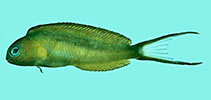
Meiacanthus bundoon Smith-Vaniz, 1976 Bundoon blenny |
|
|
photo by
Winterbottom, R. |
| Family: | Blenniidae (Combtooth blennies), subfamily: Blenniinae | |||
| Max. size: | 9.5 cm SL (male/unsexed) | |||
| Environment: | reef-associated; marine; depth range 5 - 21 m | |||
| Distribution: | Pacific Ocean: Fiji and Tonga. | |||
| Diagnosis: | Dorsal spines (total): 4-5; Dorsal soft rays (total): 26-27; Anal spines: 2-2; Anal soft rays: 16-17. Lunate caudal fin with elongated lobes in adults; live color dark olive with wedge-shaped, orange-yellow stripe along sides of body; cheek and opercle green; caudal-fin base and lobes black with centroposterior area transparent whitish with dusky rays. Dorsal rays IV-V (usually V), 26-27; segmented caudal rays 11-13 (Ref. 54980). | |||
| Biology: | Adults swim above the bottom. They feed on zooplankton. Oviparous. Eggs are demersal and adhesive (Ref. 205), and are attached to the substrate via a filamentous, adhesive pad or pedestal (Ref. 94114). Larvae are planktonic, often found in shallow, coastal waters (Ref. 94114). | |||
| IUCN Red List Status: | Least Concern (LC); Date assessed: 28 March 2009 Ref. (130435) | |||
| Threat to humans: | harmless | |||