| Family: |
Cyprinidae (Minnows or carps), subfamily: Barbinae |
| Max. size: |
80 cm TL (male/unsexed); max. reported age: 16 years |
| Environment: |
benthopelagic; freshwater, potamodromous |
| Distribution: |
Europe: Spain from Ebro to Ter drainages on Mediterranean slope and westward to Ason drainage on Atlantic slope. Introduced to central Italy in Fiora, Ombrone and Albegna drainages. |
| Diagnosis: |
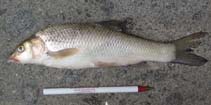
Diagnosed from other species of Barbus and Luciobarbus in Iberian Peninsula by having the following characters: lateral line with 43-48 + 2-3 scales; last simple dorsal ray slender, not serrated posteriorly in adults, occasionally with a few small, widely set serrae in individuals smaller than about 15 cm SL; posterior barbel reaching beyond posterior margin of eye; lower lip thick, without median lobe; and lower jaw tip covered by lower lip (Ref. 59043). |
| Biology: |
Adults inhabit lower and middle reaches of rivers with slow current, preferring areas with vegetation and shore cover. They migrate upstream areas with faster current and gravel or stone bottom for spawning (Ref. 59043). They feed on invertebrates and plants (Ref. 26100) and algae (Ref. 59043). |
| IUCN Red List Status: |
Near Threatened (NT); Date assessed: 26 October 2023 (A2ce) Ref. (130435)
|
| Threat to humans: |
harmless |
Source and more info: www.fishbase.org. For personal, classroom, and other internal use only. Not for publication.