
|
Homostolus acer Smith & Radcliffe, 1913 Filament cusk |
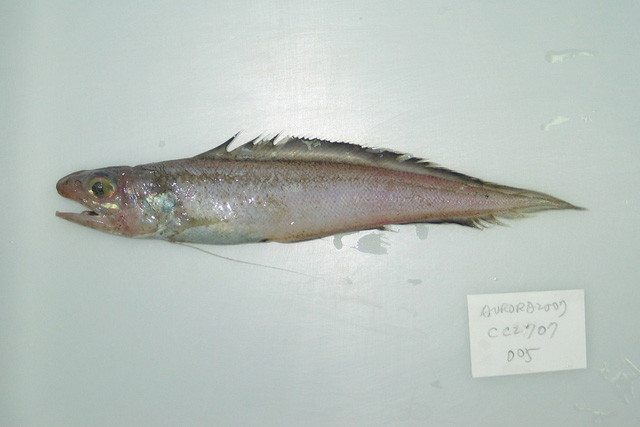
|
|
photo by
Reyes, R.B. |
| Family: | Ophidiidae (Cusk-eels), subfamily: Neobythitinae | |||
| Max. size: | 18.4 cm SL (male/unsexed) | |||
| Environment: | bathydemersal; marine; depth range 300 - 1000 m | |||
| Distribution: | Western Pacific: off Japan to off Australia and New Caledonia. | |||
| Diagnosis: | Rather elongate body with pointed head; eye diameter equal to or longer than snout; jaw teeth granular in narrow bands; opercular spine sharp and straight; 1-3 sharp spines on lower margin of preopercle; median basibranchial tooth patch 1; developed rakers on anterior gill arch 27-42; pectoral fins low on the body; each pelvic fin with 1 ray longer than head; precaudal vertebrae 13. | |||
| Biology: | Benthopelagic at bathyal depth (Ref. 56809). Found on the continental slope (Ref. 75154). Common species (Ref. 34024). Oviparous, with oval pelagic eggs floating in a gelatinous mass (Ref. 205). | |||
| IUCN Red List Status: | Least Concern (LC); Date assessed: 16 August 2019 Ref. (130435) | |||
| Threat to humans: | harmless | |||