
|
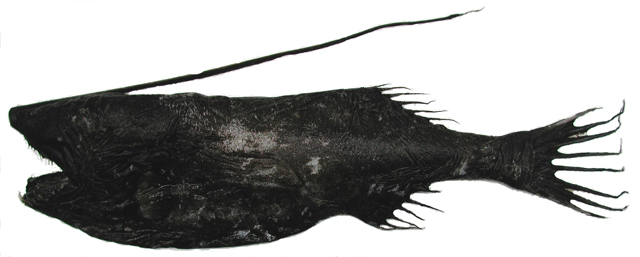
Gigantactis vanhoeffeni Brauer, 1902 |
|
|
photo by
Ho, H.-C. |
| Family: | Gigantactinidae (Whipnose anglers) | |||
| Max. size: | 62 cm TL (female) | |||
| Environment: | bathypelagic; marine; depth range 300 - 5300 m | |||
| Distribution: | Tropical and temperate parts of all oceans. North-eastern Atlantic: single record at 62°39'N, 33°45'W. Absent from Mediterranean (Ref. 36125). | |||
| Diagnosis: | Dorsal spines (total): 0-0; Dorsal soft rays (total): 6-7; Anal spines: 0-0; Anal soft rays: 6-6. Esca covered with minute spines and bearing distally-flattened papillae; elongate, darkly pigmented distal prolongation attached to escal bulb; short, black filaments concentrated around tip of the prolongation; escal bulb with 2-3 unpigmented filaments; close-set pair of small appendages on posterior margin of illicium some distance below bulb (Ref. 13608); length of illicium less than 120% SL (71-112% SL in specimens greater than 25 mm); relatively long dentary teeth (longest 2.6-5.0% SL) in three longitudinal series; length of rays of caudal fin less than 45% SL (Ref. 86949). | |||
| Biology: | Rarely caught (Ref. 559). | |||
| IUCN Red List Status: | Data deficient (DD); Date assessed: 15 July 2014 Ref. (130435) | |||
| Threat to humans: | harmless | |||