
|
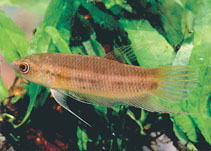
Betta chloropharynx Kottelat & Ng, 1994 |
|
|
photo by
Armitage, D. |
| Family: | Osphronemidae (Gouramies), subfamily: Macropodusinae | |||
| Max. size: | 5.86 cm SL (male/unsexed) | |||
| Environment: | benthopelagic; freshwater | |||
| Distribution: | Asia: Banka, Indonesia. | |||
| Diagnosis: | Dorsal spines (total): 0-1; Dorsal soft rays (total): 8-9; Anal spines: 2-2; Anal soft rays: 27-28. Differs from Betta hipposideros in the following characters: µ-shaped black throat mark (vs. horseshoe-shaped black mark); absence of both dorsal and caudal transverse bars (vs. presence); fewer subdorsal scales (mode 5-6 vs. 6 1/2). Distinguished from Betta renata in the following characters: µ-shaped black throat mark (vs. kidney-shaped); absence of both dorsal and caudal transverse bars (vs. presence); non-spotted opercle (vs. spotted opercle); opercle with yellow lower margin (vs. black margin); fewer subdorsal scales (mode 5-6 vs. 6 1/2). Can be differentiated from Betta spilotogena in the following characters: µ-shaped black throat mark (vs. black median spot); non-spotted opercles (vs. spotted opercle; and an opercle with yellow lower margin (vs. back margin) (Ref. 56386). | |||
| Biology: | Occurs in a secondary forest area in a pool among leaf litter. | |||
| IUCN Red List Status: | Critically Endangered (CR); Date assessed: 07 January 2019 (B2ab(iii)) Ref. (130435) | |||
| Threat to humans: | harmless | |||