
|
Barbatula nuda (Bleeker, 1864) |
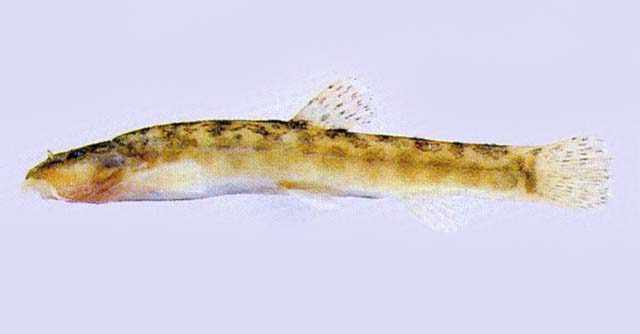
|
|
photo by
Kim, I.-S. |
| Family: | Nemacheilidae (Brook loaches) | |||
| Max. size: | 22 cm TL (male/unsexed) | |||
| Environment: | demersal; freshwater | |||
| Distribution: | Asia: China, Korea and Japan. | |||
| Diagnosis: | Dorsal soft rays (total): 10-10; Anal soft rays: 8-8; Vertebrae: 40-42. Distinguished from all other species of Barbatula from northern Asia by having an upper lip with a marked and deep median indention (vs. slight and shallow) and a nearly scaleless body or scales only on the caudal-fin base (vs. body scaled posterior to the dorsal-fin origin or a fully scaled body). Can be further diagnosed from B. dgebuadzei in having closely-set nostrils (vs. widely separated) and 40-42 vertebrae (vs. 43-45). Similar to both Barbatula altayensis and B. sawadai in the shared presence of closely-set nostrils, a character distinguishing them from all other congeners from northern Asia with widely separated nostrils. Can be further diagnosed from B. altayensis in having 40-42 vertebrae (vs. 44-45), and from B. sawadai in having 7 branched dorsal-fin rays (vs. 8). Resembles B. compressirostrisi (or B. golubtsovii) and B. dgebuadzei in scalation in that the body is scaleless or scales only on the caudal-fin base. Further differs from B. compressirostrisi (or B. golubtsovii) in having 40-42 vertebrae (vs. 45-47) and closely-set nostril (vs. widely separated) (Ref. 93050). | |||
| Biology: | ||||
| IUCN Red List Status: | Least Concern (LC); Date assessed: 28 May 2020 Ref. (130435) | |||
| Threat to humans: | harmless | |||